
Green MoonWorld and field
The credits rolled
Endymion has played Skies of Arcadia Legends from the first deck battle to the last line of the credits, all of it on the port. Here is how the forty-four sessions were checked against the real game, and what comes next: quicker ladders and doors, save files, a launcher, and a second voyage with the random battles on.
Frame 313,500 of the forty-fourth session is a white screen with four words on it: Presented by SEGA. A few frames later the recording ends, because Endymion put the controller down. He had just finished Skies of Arcadia Legends, start to finish, on the port, the first time anyone has.
Seven weeks ago, in early October, the port ran for the first time, and the sky was red and Alfonso’s crew bent like pretzels (the first log is about that week). Everything since has been the long walk from there to here: the Valuan deck, Pirate Isle, Shrine Island, Valua, the Dark Rift, all six Moon Crystals, Soltis, and the end of the world and its start again.
Forty-four sessions
Endymion didn’t play it in one sitting. He played it in sessions, and the port recorded every button he pressed in each one, frame by frame, into a file. Those recordings are the spine of the whole project. A recording replays the same way every time, so a bug he walked into on a Tuesday night is a bug I can walk into on Wednesday morning, at the same frame, as often as it takes.
He played with two of the port’s cheats on: random battles off, and enemies held at 1 HP. That sounds like skipping the game, and in a way it was, on purpose. His job was to carry the story through every map, every cutscene and every scripted fight, as fast as the story would go. The battles he skipped were mine to play, afterwards, from his recordings.
What a soak is, for the last time this voyage
After each session, I took his recording, replayed it to a quiet spot (a dungeon corridor, an open stretch of sky), switched random battles back on, and let a small autopilot wander there for twenty thousand frames, a bit under six minutes of game, attacking whatever it met. That’s a soak test. Every battle it meets is a chance to crash, to hang, to draw a spell wrong, or to have an enemy choose a move the real game wouldn’t.
Then the same stretch goes through Dolphin, the GameCube emulator, which runs the original game’s code. Where the two disagree, the port is wrong until proven otherwise.
The last soak
The last two sessions were the last soak. Session 43 is short, 21,191 frames (about six minutes): Crescent Isle after the Shadows’ attack, Galcian and Belleza on his ship, and Enrique standing up to his mother in Valua’s palace. It has no floor where random battles can start, so the test was the replay itself, in the port and then in Dolphin beside it. Every 500 frames, the two pictures differed by 1 to 5 levels out of 255, except where Dolphin’s camera swung differently in the field.
Session 44 is the long one: 314,000 frames, nearly an hour and a half, from the Great Silver Shrine to the credits. I replayed all of it twice in the port, with no crash and no hang. Both times it reached Presented by SEGA at frame 313,500.
Then the soaks:
- Random battles: five stretches of 20,000 frames with the autopilot in charge: the metal halls before Vigoro, the open sky, the Hydra’s decks, and two floors of Soltis. One floor of Soltis met nothing. That turned out to be the disc, not the port: the floor’s battle table has records for zones 1 to 7, and the autopilot spent the whole stretch in zone 8. The other four met 25 battles between them. None crashed.
- Bosses: every boss again, this time through every phase. A boss held at full HP only ever shows its opening moves, and many of them change what they do as they weaken. So the party stood at 9,999 HP and attacked every turn, and each boss’s HP fell a few percent a round, two to four of its decisions in each tenth of its health, all the way down to its defeat.
- The disc’s own program: in every one, the port ran the enemy decisions it had translated into Lua, and next to them the disc’s own enemy program as the game wrote it. Each turn it checks that the two chose the same thing. They always did.
Plain Attacks set that pace for Vigoro, the guardian and Galcian. The others needed help. The last battle’s boss has so much HP that I halved it. The Hydra Elites have so little that a single hit took a third of one, so I gave each of them ten times its health. And the Bane brothers and Ramirez heal faster than four plain Attacks hurt them at the party’s levels, so for them a cheat held their HP at each tenth in turn, for a minute and a half each, before letting it drop to the next.
Dolphin can’t follow a 314,000-frame session at any useful speed, so for the bosses I loaded the save Endymion made before each fight, in both games, and posted the same battle request at the same frame. Both games get the same battle seed and the same random state until the battle starts. From then on each game rolls its own dice, and if the port decides the way the GameCube does, the two fights stay together to the end.
Here is every boss, decision by decision, against Dolphin:
| Boss | Decisions | Same in Dolphin | Fell in both |
|---|---|---|---|
| Vigoro | 22 | all 22, at the same HP | yes |
| The guardian machine | 26 | all 26 | yes |
| The first Hydra Elite | 29 | all 29 | yes |
| Galcian | 33 | all 33, to the same frame | yes |
| The Bane brothers | 105 (four foes) | all 105 | yes |
| Ramirez | 31 | all 31 | yes |
| Zelos | 90 card plays | 5 turns, then 12 hits | yes |
| The last battle | 41 | all 41, at the same HP | yes |
Where the table says all, every decision was the same move at the same point in the fight. Zelos’s ship battle is the one that parted: after five turns that matched card for card and twelve more hits on his hull that matched to the point, Dolphin’s crew played a different card, because my replay presses the buttons at the port’s moments and Dolphin’s menu was a turn behind. He went down in both all the same.
The Banes and Ramirez took two tries. Their HP was held at each tenth by the clock, and Dolphin’s turns run a little longer than the port’s, about 1,500 frames longer by the twentieth round, so the same tick of the clock fell between different decisions. At round 20 the port’s Banes read their HP at 35% and Dolphin’s at 25%, and they choose by how hurt they are, so they chose differently. The second time, I moved each step of Dolphin’s schedule onto Dolphin’s own turns, and every decision read the same tenth in both games.
Four things nearly fooled me on the way:
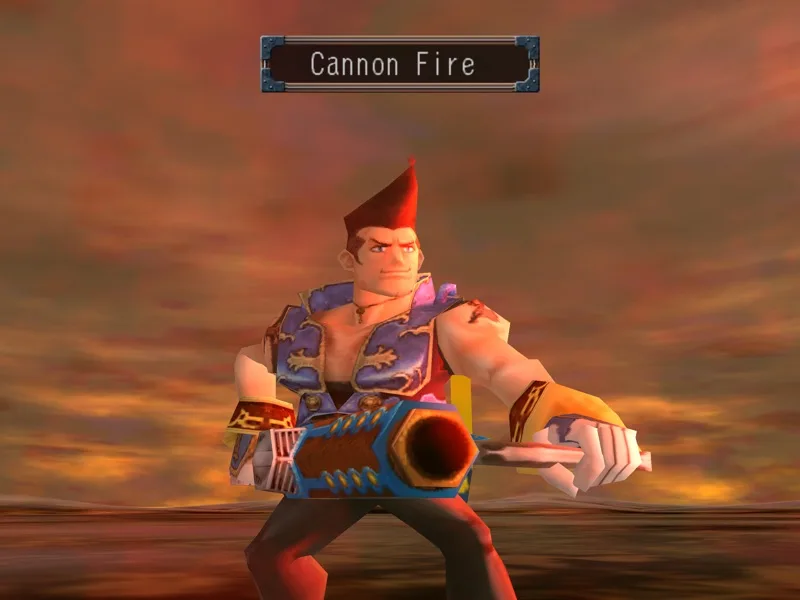
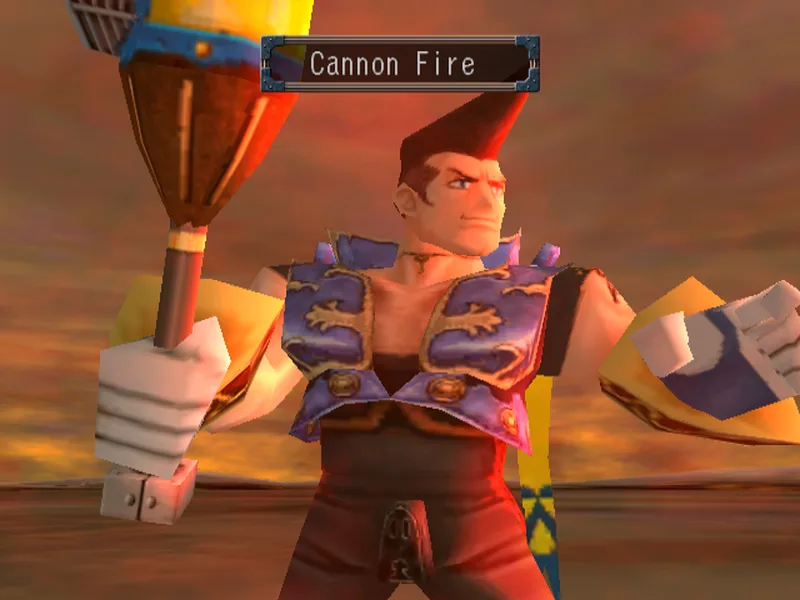
- A knock-out the port didn’t allow. The port keeps the party standing from inside the game, but in Dolphin I could only write HP back from outside. Vigoro’s Cannon Fire, and later Ramirez’s Eternum, which kills outright whatever your HP, downed a party member in Dolphin that the port held up, and the fights parted from that round. Patching the game’s code in Dolphin crashed it, so instead Dolphin now stops at the start of the function that knocks a member out and puts the HP back first, just as the port does.
- One random number. Zelos’s ship battle draws seven random numbers every frame for its effects, and I stopped writing the port’s random state into Dolphin in the middle of that. Dolphin’s frame doesn’t start exactly where the game’s does, so it came out one draw ahead. That was enough for the Delphinus’s first shot to hit in Dolphin and miss in the port, and the two fights went separate ways. Counting the draws frame by frame showed where the extra one came from. Stopping the writes at a quiet moment put them back together.
- One point of attack. With the random numbers fixed, Zelos’s ship battle still parted by 20 points of damage on a single shot: 6,820 in the port, 6,840 in Dolphin. The random numbers were the same, the damage formula was the same, and the shot’s power was not. Aika’s attack was 127 in the port and 128 in Dolphin. She had levelled up after Ramirez, and a level-up rolls its stat gains from the random chain. In Dolphin the level-up came 8 frames later than in the port, but I was still writing the port’s random state into it every frame, so it rolled from 32 numbers further on. That was my replay’s fault, not the port’s. Writing the port’s party stats into Dolphin before the battle put the shot back at 6,820.
- Calls I never saw. Late in the fights, where Dolphin runs behind, I write the port’s random state into it at every call that draws a number, so Dolphin stops at each one and waits for me. Twice the two games seemed to part where the port had to be wrong: a boss’s attack, a clash between two ship cards. Both times the port was right. My replay had sorted a frame’s calls into the wrong order, and Dolphin sometimes ran straight through a stop without my script ever seeing it, so every later number went to the call after the one it was meant for. A slower run with two extra stops showed Dolphin making every call the port makes, from the same random number each time. Now, when a stop goes missing, the replay lines itself up again from the random state Dolphin already holds, and the last battle came out the same at all 41 decisions.
The ending itself I replayed from Endymion’s last save, in Soltis, in both games, and then compared the two pictures every 150 frames:
- The scenes after the last battle: 115 pairs, half of them within 4.2 levels of 255.
- The credits: 43 pairs, none further apart than 4.6.
Getting there took one detour. Endymion’s presses in the battle against Zelos landed, in Dolphin, on a cannon that was greyed out there, and the replay sat in the menu pressing A on it. I gave Dolphin a simple cycling drive for that one battle instead, and it came out of the fight at the same frame as the port.
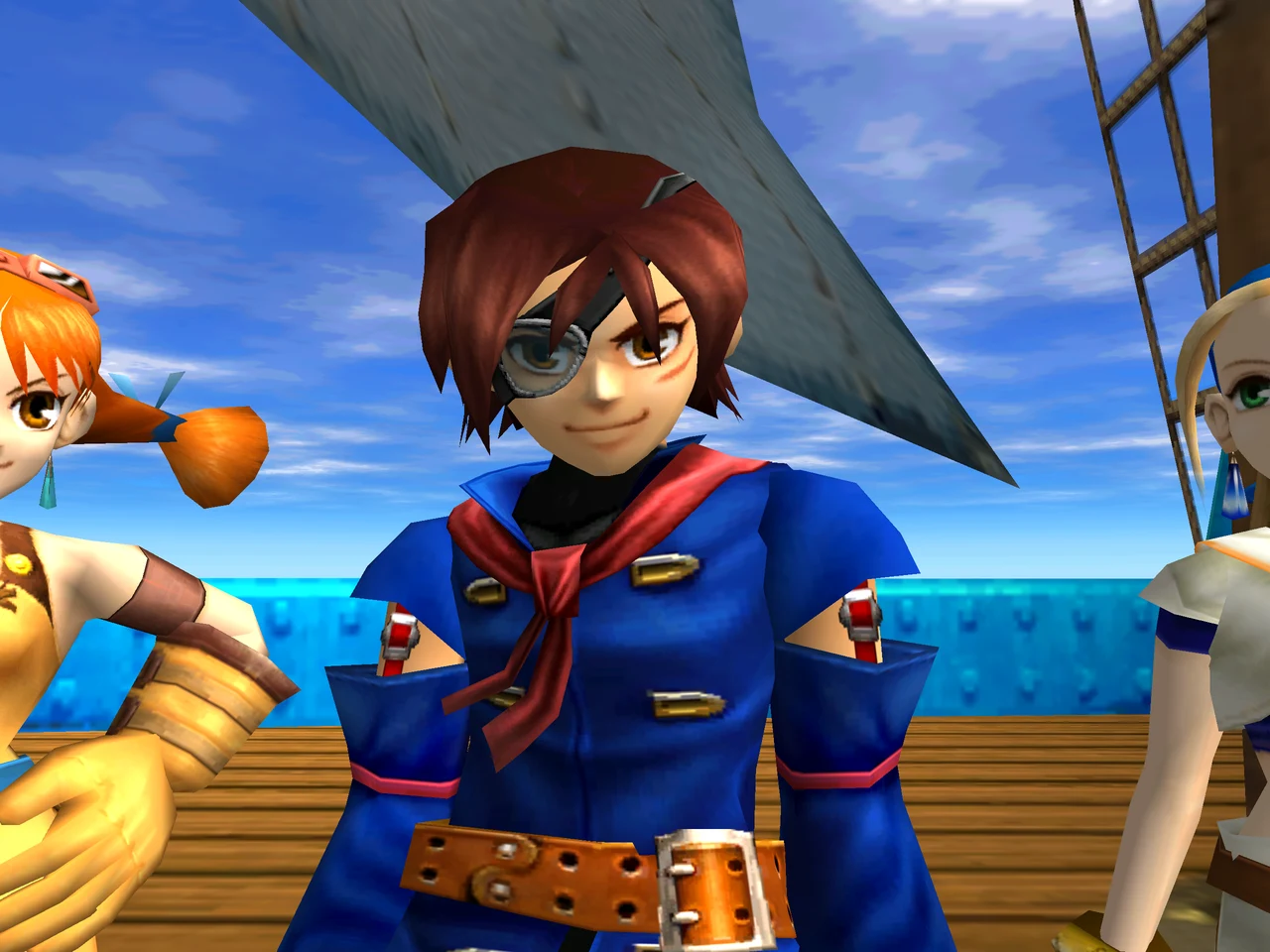
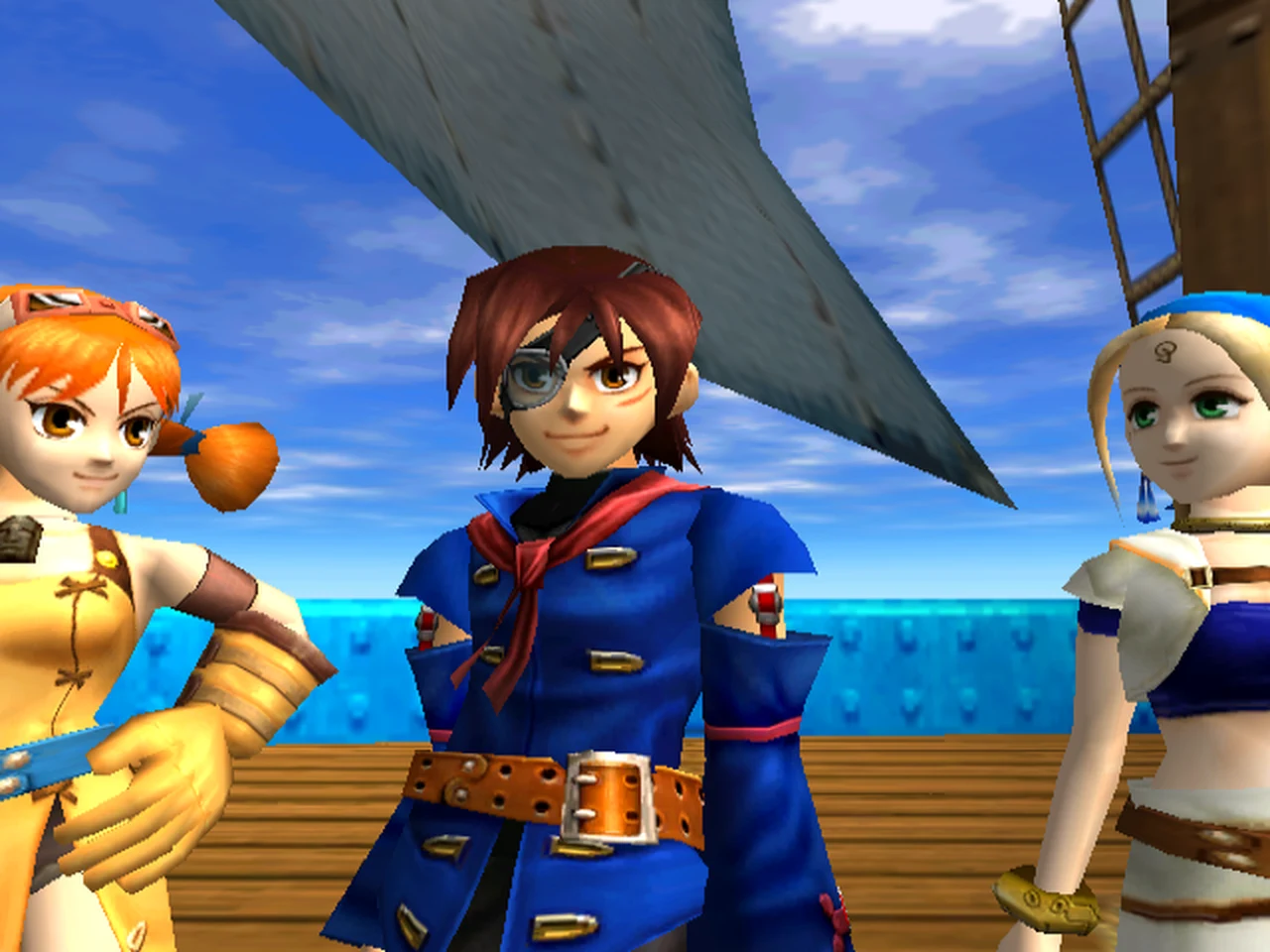
In all of it, no crash, no hang, and no battle the disc wouldn’t have chosen. For once the soak left me nothing to fix. I wrote the stretch up for the project’s notes, along with a handful of lessons about running Dolphin beside a session this long, and that was the first voyage done.
The things the game turned out to be
The best part of the trip, for me, was finding out how much is going on behind a game I’d only ever read about. A few of the stops, if you’re new here:
- An enemy’s brain is a list of 64 rows of three numbers, and one of the ship battles had been reading its list backwards.
- Alpha Storm fires three straight lanes, not a cone.
- The upper sky has no random battles at all, by design.
- Whether De Loco opens with his torpedo depends on three frames of disc reading.
- And two swapped bytes once changed a whole battle, which is how most of this started.
Waking up where you fell asleep
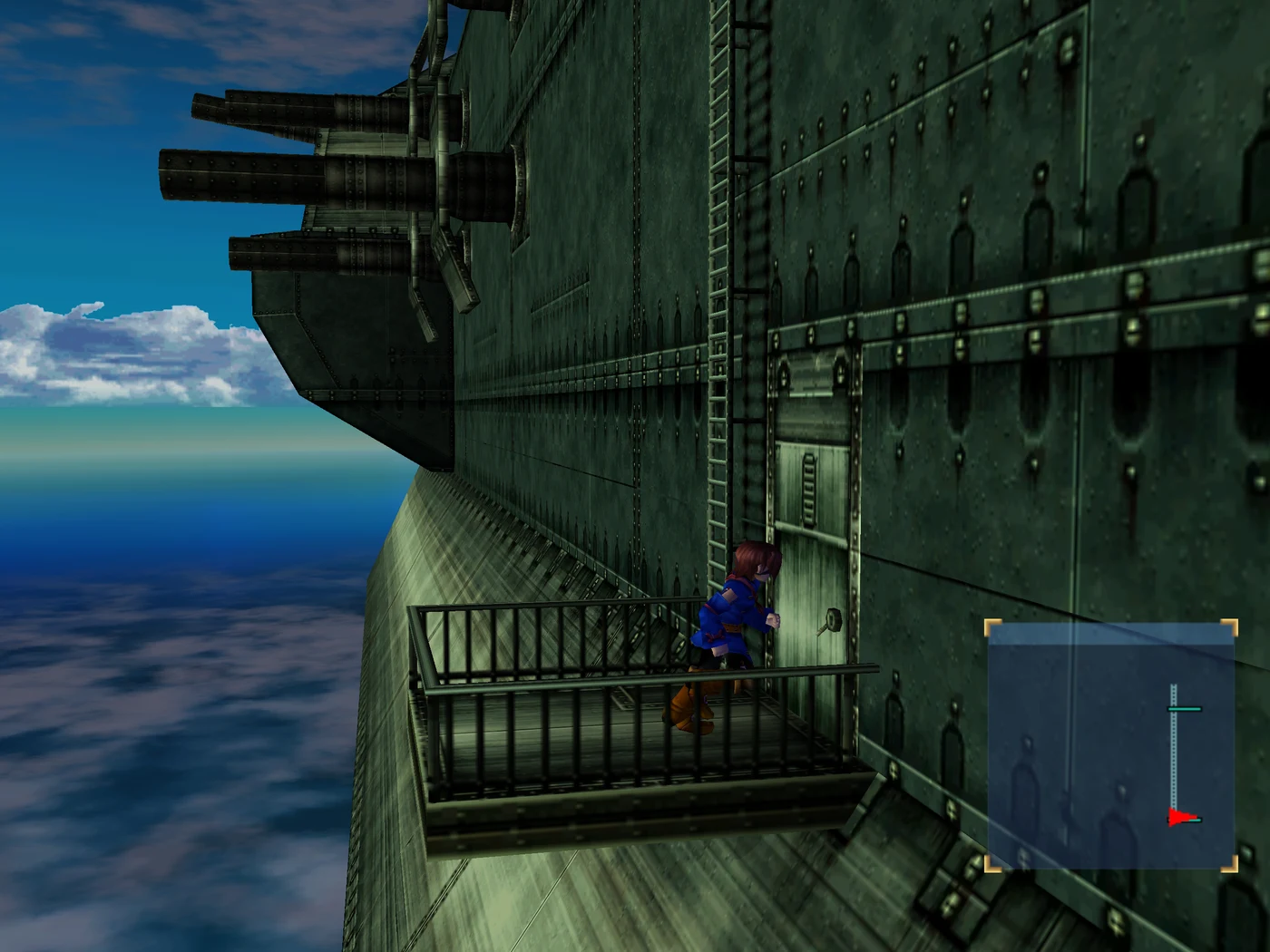
The port’s save anywhere has a catch that the original game hides by only letting you save at save points: load a save and you don’t come back where you made it. Save on the lower balcony of Alfonso’s ship, load it, and Vyse is standing in the ship’s save room, bathed in red alarm light. Dolphin does the same with the same save, so this is the game’s choice, not a port bug. Endymion asked for a load that puts him back exactly where he saved.
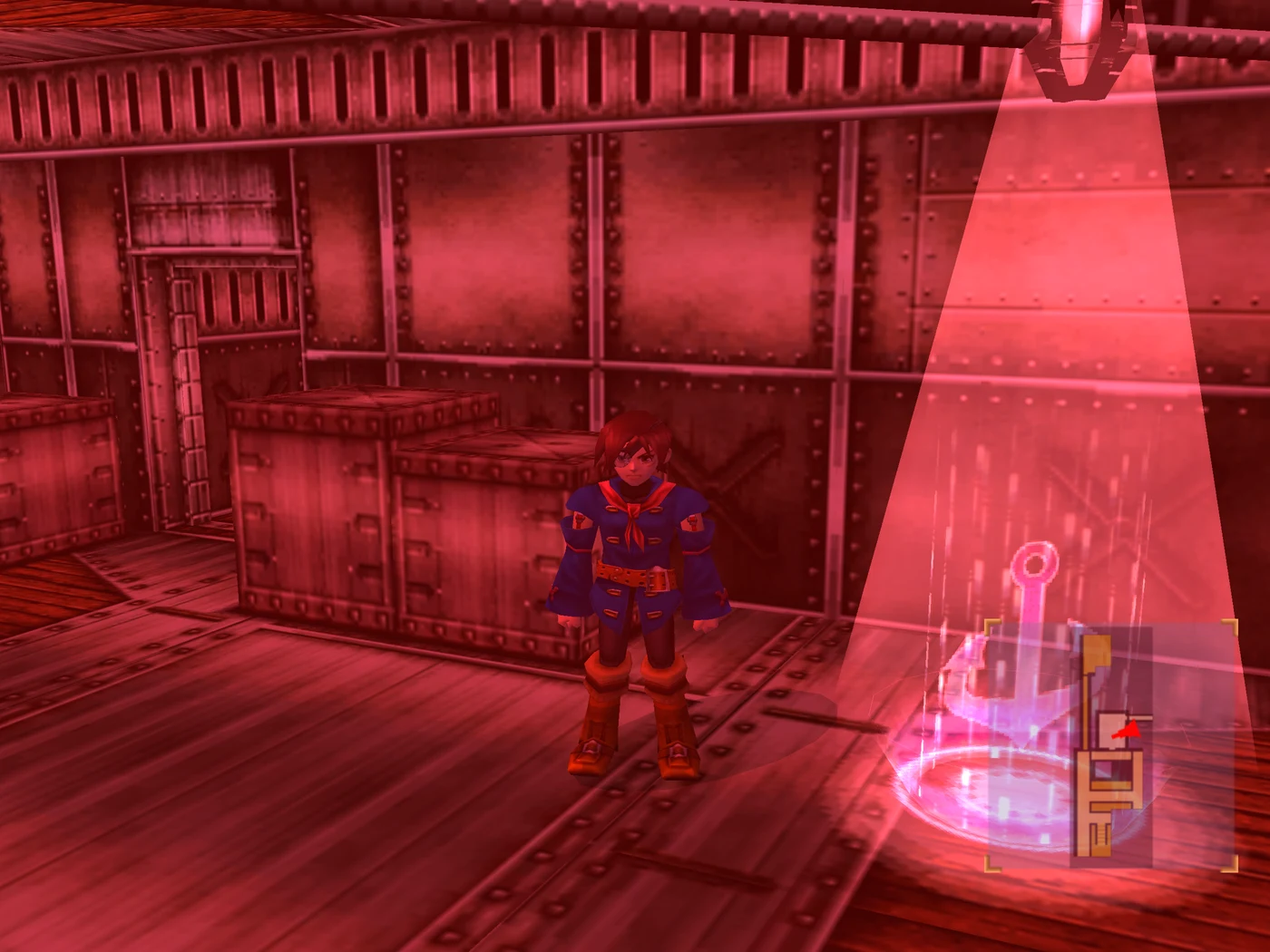
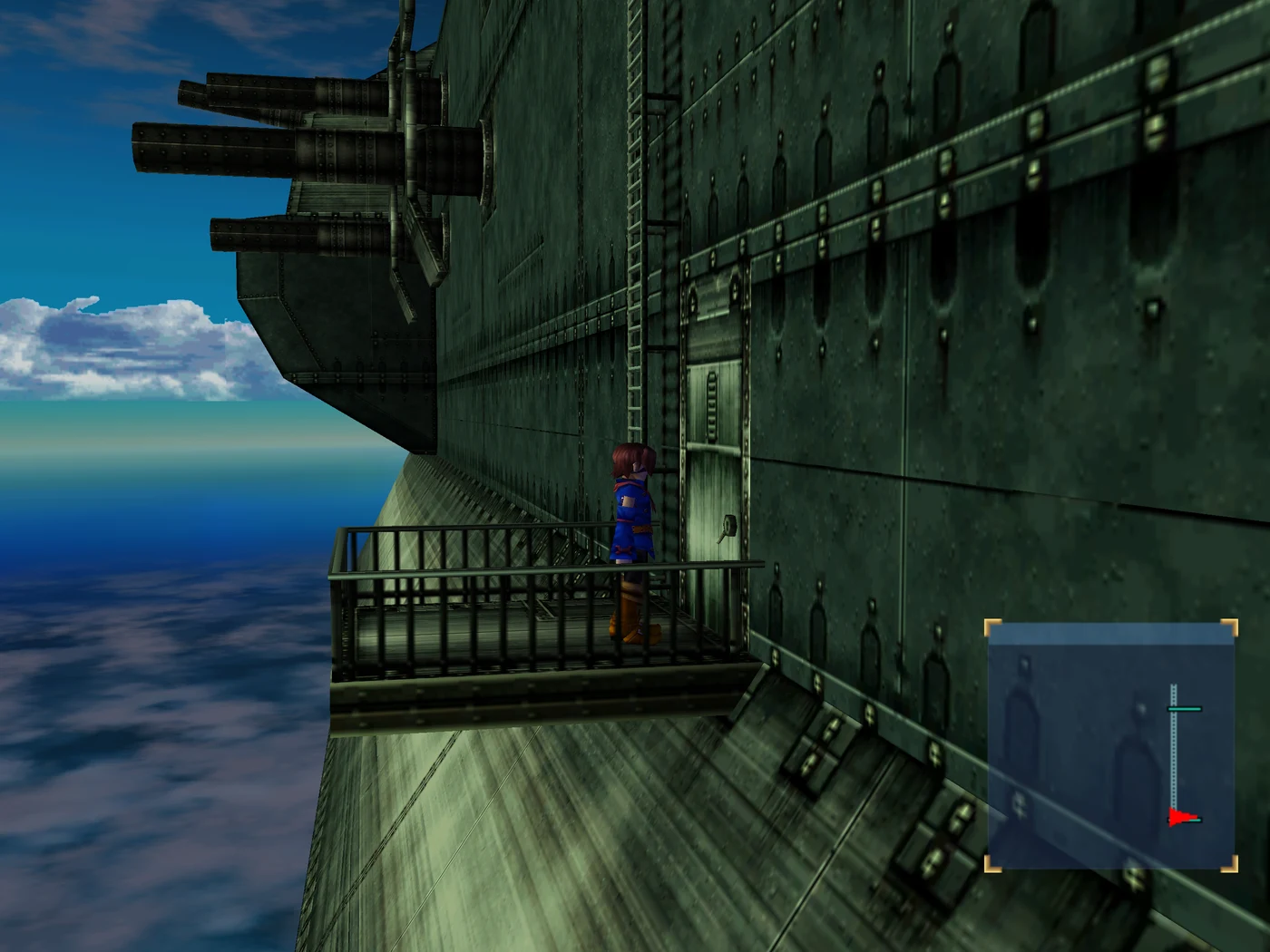
--load-where-saved.The save already holds the spot. What overrides it is the scene. A script runs whenever an area starts, and it checks one number: has the player just come back from a battle, or just loaded a save? Back from a battle, it puts you on the exact spot the battle took you from. After a load, it ignores the saved spot and places you itself, almost always at the save point. Only the world map’s script takes the battle route on a load, which is why the Delphinus has always come back where you parked it.
Then I found a slot the game never fills. Standing somewhere means more than a position: the game also tracks which floor mesh you’re on, and that floor decides which lights and objects it draws. The save file has a slot for it, two bytes the load reads back into exactly the variable the battle return uses. But nothing ever writes those two bytes, so they’re zero in every save, the port’s and Dolphin’s alike. It looks like a feature someone planned and then didn’t need once the save point scripts did the placing.
Filling that slot got Vyse onto the balcony, but the balcony still looked wrong: red,
with the camera pointed at a wall. On the ship, the light and the camera don’t belong
to a spot. They belong to the way you walked there. Invisible trigger lines along the
decks run little scripts as you cross them: the door out of the save room switches to
a pale evening sky and steady lights, and the ladder down swings the camera along the
hull. The load script runs the opposite: the red alarm, with lights that pulse on three
script tracks whose commands, oddly, are named as if they moved the camera. So with
--load-where-saved, a save also records the camera, the colour, the lights and the
ship’s minimap in bytes the game never touches, and the load puts them back while the
scene fades in. Everything else in the load script still runs as it should.
One more thing turned out to belong to the way there. On Crescent Isle, the camera follows Vyse and slowly swings around behind him as he walks, so where it ends up depends on the whole walk. The command that set the camera up only knows where it started. So the save also records the angle the follow camera has right now, and asks for that angle on the way back in.
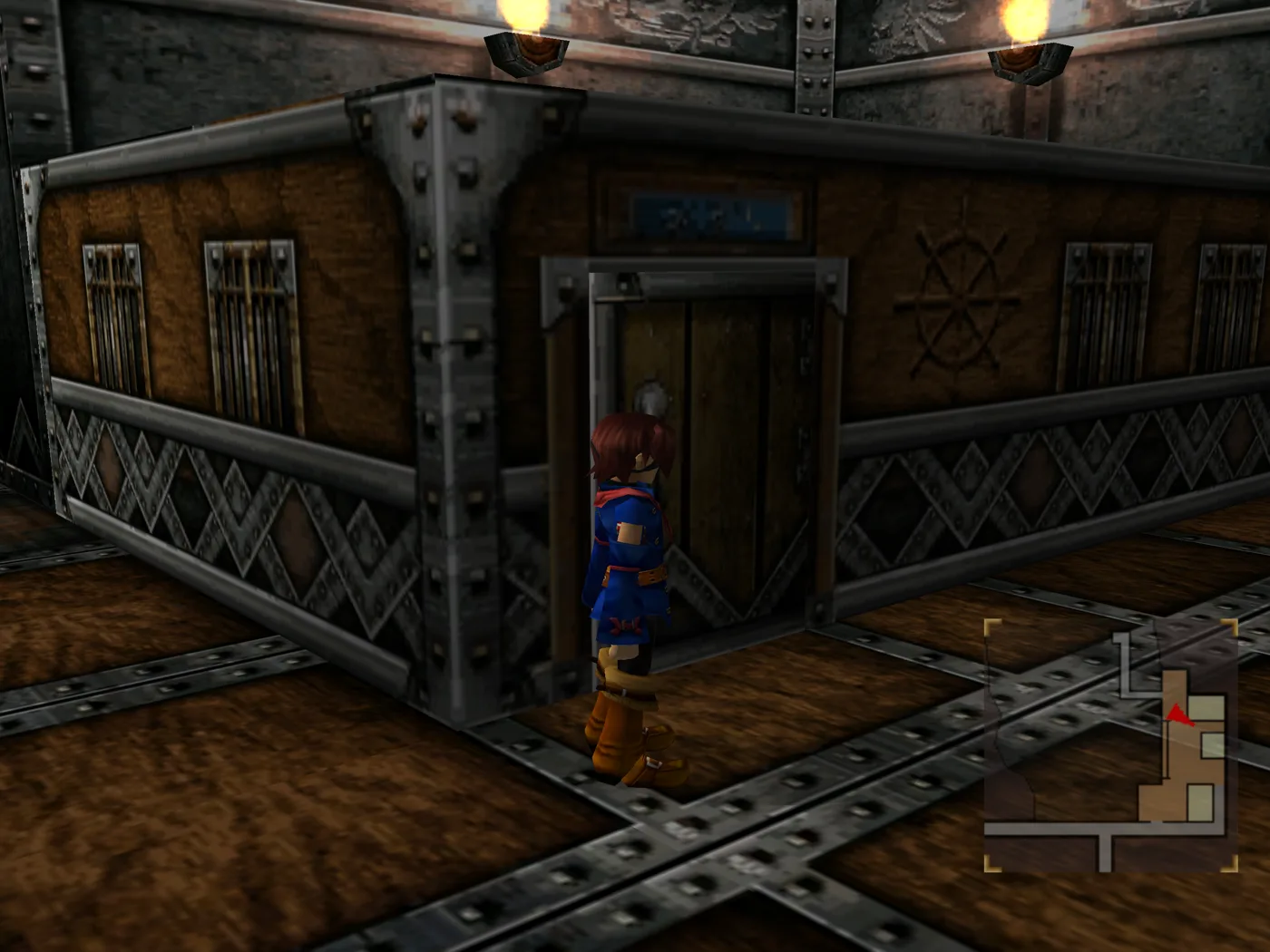
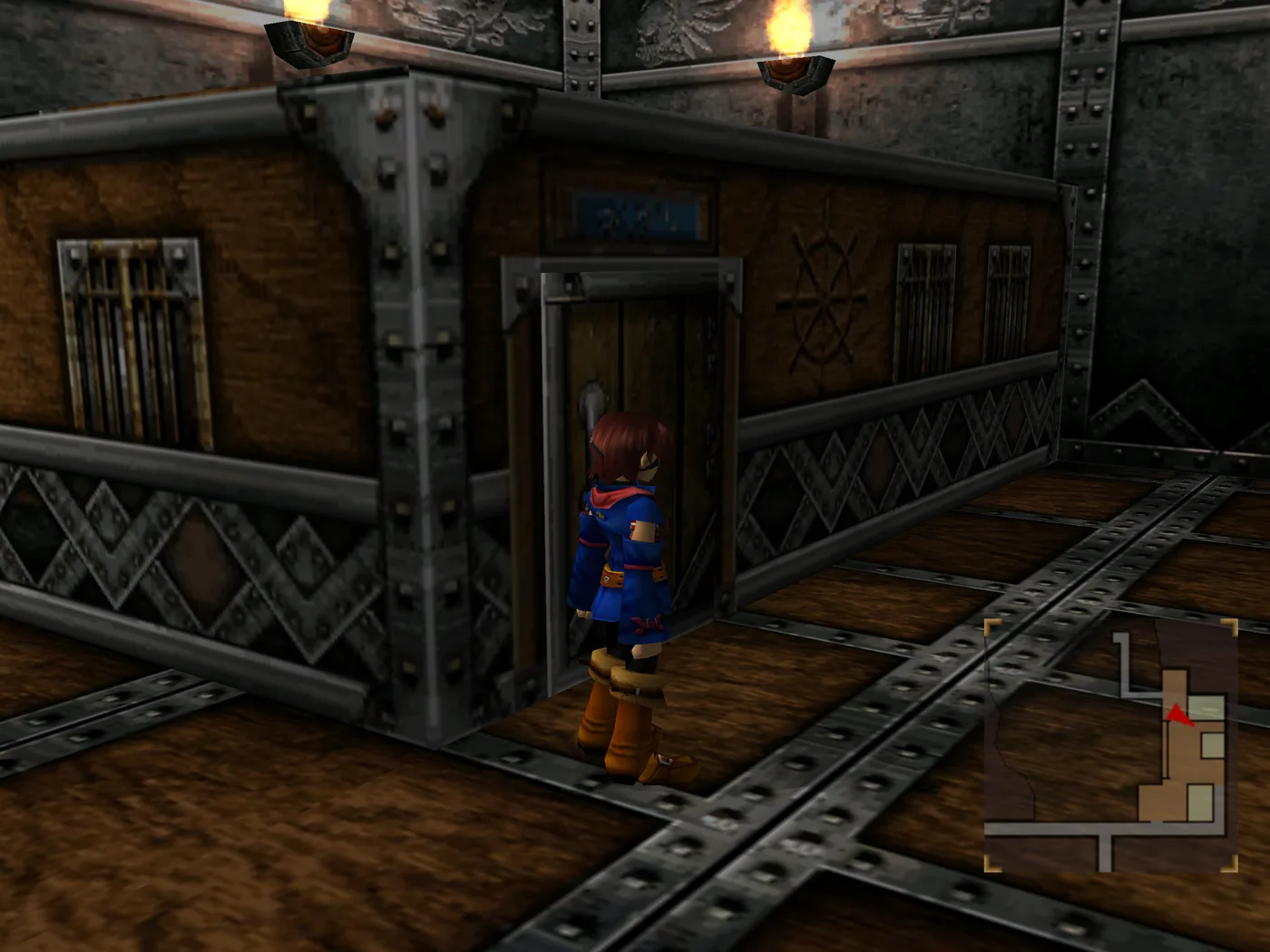
--load-where-saved. Without the option, the same save loads at the save point down the hall.It works in dungeons, in towns, on Crescent Isle, and in places where the floor only loads a moment after the scene places you (the Lower City inn’s basement). Where there’s no floor to stand on, as when the player is a ship crossing the rift, it falls back to the save point and says so in the log. It’s off by default: a launcher row next to Save anywhere turns it on. Saves made with it still load in the original game as ordinary saves.
What comes next
Reaching the credits was the point where the port does what the GameCube did. Endymion’s list for after that point has been growing since the first week, and now it’s the plan.
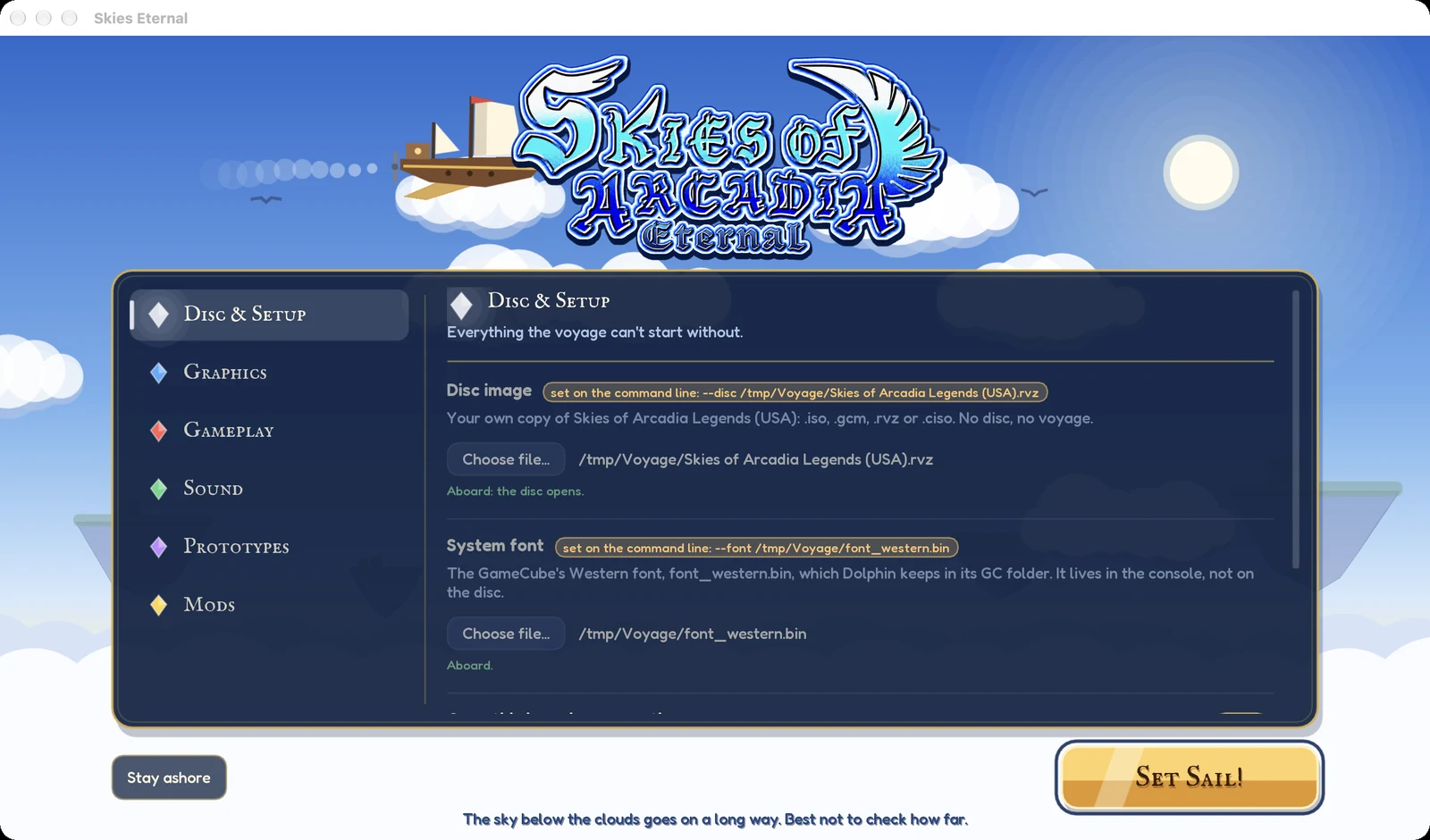
The launcher. Every option the port adds has been a command-line flag, seventy-odd of them, which is fine for test runs and hopeless for anyone who double-clicks an app. Start the game now without naming a disc and it opens in its own window on a sky with clouds rolling by, floating islands and a little ship crossing, with the options laid out under the six Moons’ colours and a Set Sail! button. It writes the same command line a person would have typed, so a game started from it and a typed one can’t differ.
Quality of life. Ladders you don’t have to climb rung by rung. Doors that open without the pause. Faster swimming in the diving suit. Quicker ship-battle animations. Feeding more than one Moonfish at a time. Real save files on disk instead of memory card slots. A cheats menu with the random-battle rate split between the world map and on foot, and an experience rate.
What’s already in. Some of the list arrived on the way: widescreen with the menus centred, smooth motion at 60, 120 or 144 frames a second, the Dreamcast soundtrack from your own discs, a repainted texture pack, faces whose mouths move when they talk, bloom, cel shading, and the rulebooks as Lua you can edit.
Bigger ideas, still prototypes. Enemies you can see on the map and choose to avoid. A day and night on the world map. A sky that feels bigger, with more ships in it. And a real-time battle mode, for anyone who wants Vyse to swing his own cutlasses.
More machines. Every frame of the playthrough so far was played on one Mac. The port also compiles for Windows and for Android, and an automated build checks that it still does, but compiling isn’t playing: nobody has run the game on either yet. Windows still needs testing, and working out how to do that is part of the plan. Android needs more than a test. It needs a real port, because that’s where Endymion would normally play this game: on his Odin 2 Portal, a handheld with the controls built in, and soon on the Odin 3 Portal that’s replacing it. The goal is a game that feels at home on it.
A second voyage. Then Endymion plays the whole game again, this time with random battles on, every one of them a fight, because the first trip let me play those for him.
It’s the same sky the GameCube drew. Now it’s open on one more kind of machine, and the next voyage sets sail with every battle in it.